
Rhode Island third-grader Cara Madison set to race in ‘Little 500’ for family, girls and speed
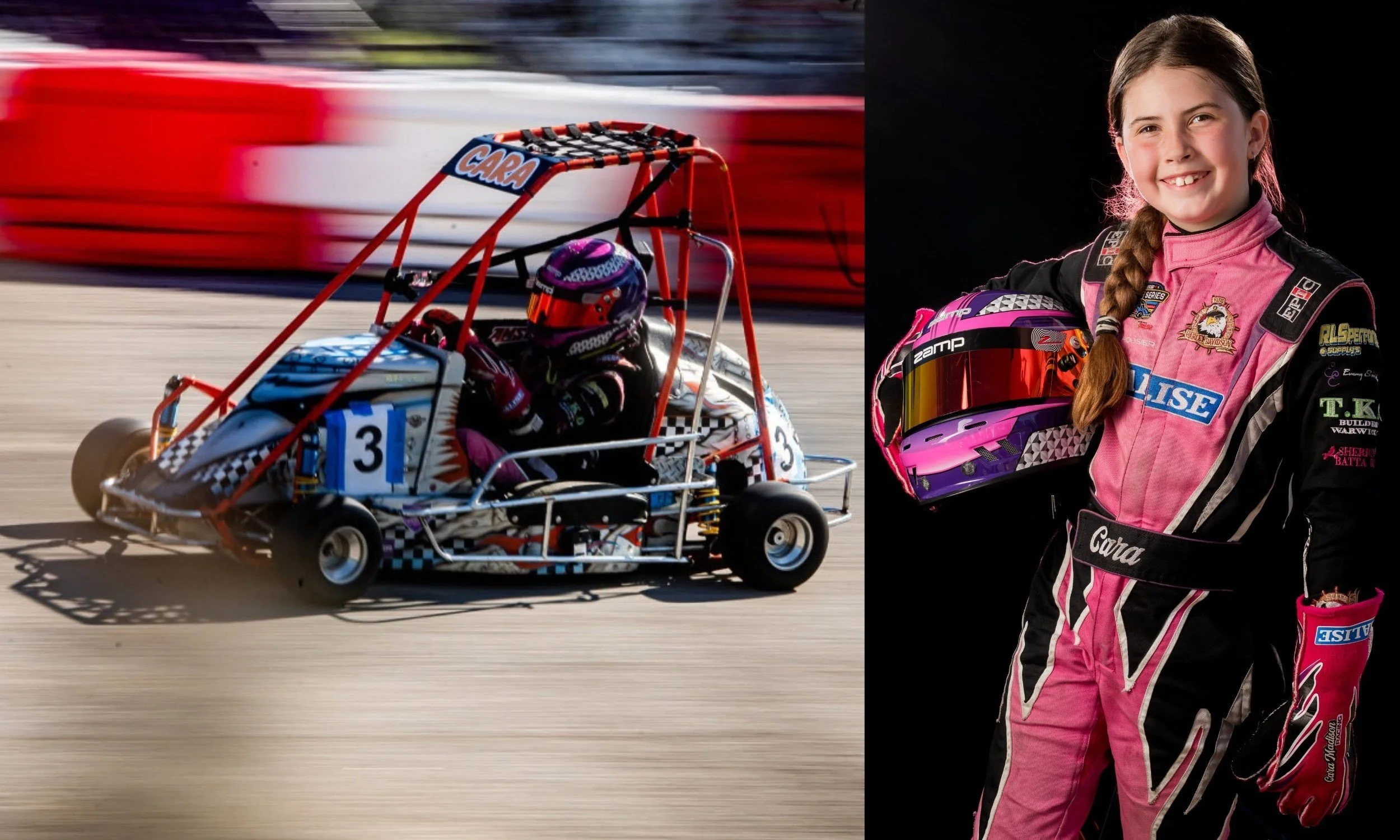
Cara Madison is competing in the “Little 500,” which features young drivers in scaled-down open-wheel cars, often attracting talent from across the United States, known for its big-event feel similar to major pavement sprint car races but for kids.
When Cara Madison Leavitt was five years old, she jumped at the chance to participate in a 10-lap race.
At a local "Arrive and Drive” event in Thompson, Connecticut at Little T Quarter Midget Club — a popular fundraiser that allows quarter midget racing — drivers ages 5 to 16 can sign a waiver and pay to drive a race car.
That was when Cara first caught the racing bug, when driving solo on the track.
"What kid doesn't want to do that?" her mom, Jessica Beaupre, told Female Athlete News. "We had done that in the past with our grandson, so I said to Dad, 'Hey, we should just take Cara. Let her go do it just for fun, you know, just because we did it before.'"
In her first-ever race, Cara spun out and loved the thrill.
A few months later, the five year old had another chance. Her parents invited their grandson.
“She was all-in,” Beaupre said about Cara. “We thought it would be fun for them to do it together. And, that was probably the worst thing that we could have done because it created a lot of competition.”
On the drive home, Beaupre said Cara mentioned a few times, “I beat you. I beat you. I went faster.”
“There is a five-year age difference between them, and it was very humorous seeing the different responses,” Beaupre said.
Cara is now 8, standing at 54 inches tall, and is set to compete December 27 in the ‘Competitive Division’ at the “Little 500” hosted by the New Smyrna Quarter Midget Racing Association in Florida.
After her first taste of speed, Cara and her parents went to work on creating her path and turning her dream of becoming a female race car driver into reality.
The NASCAR family favorite is No. 9 Chase Elliott, but she is also inspired by female drivers.
Depending on the day, Cara might spend minutes to hours at the track in preparation, development, and practicing.
She competed in the ‘Rookie Division’ at the Little 500 last year, when she was forced into another learning moment.
On her third lap in her first national race, she was “black flagged” when she was “avoiding a crash,” Cara said.
“If you drop four tires, like your car goes in the infield, and you don’t stop, you get black flagged,” Beaupre said. “They throw a caution flag, and then everybody gets to reset. But in her mind, she thought she was forced in, so she didn't think that… and she didn't, like, go across the infield. It was just a small, little bit. So she thought she was in the clear, but unfortunately, that was not the case. So, huge teachable moment.”
Despite being a rookie, where the idea is to pull the driver aside and tell them what they did wrong instead of stopping them in their tracks, the lesson from last year has so far been learned.
“She hasn't made that mistake again,” Beaupre said.
Cara has moved forward, winning in both state and regional competitions finishing in first and second places.
“She finished second in the Junior Honda, too,” Beaupre said. “So, I mean, for me, being a little girl like her, going out, and competing against some of these boys, who are older than her and have been doing it, I feel like she's got a little bit of a niche. I don't know what that niche is, but it's in her.”
It’s in her in the way she knows how to manipulate the accelerator instead of smashing the brakes. She’s learned how to not have a short fuse when another driver swerves and it messes up her cruising.
And, it’s in her smile when she talks about wanting to move to the next step at warp speed.
“We’ll be driving down the road, and you know, if we’re behind a slow car, the comment will come out, ‘I can go faster in my race car,” which maxes out at about 30 mph, Beaupre said.
The third grader has received attention from her elementary school teacher, who has shared videos of Cara in action. She’s driven by a passion to show up, where not many young girls can be found.
She’s already tapped into a merch line, helping designers with her own fashionable ideas.
And, then in the next minute, she’ll have a drill in her hand at the track to help her dad with the mechanics.
While her parents are proud of her humble demeanor, her dad said he’s pumped that she has had her moment. She is building her rep through her relationships with sponsors, like Balise Chevrolet of Warwick, who covered the cost of her suit and canopy.
As her marketing gains attention, her parents said that she’s attracting what she’s putting out there.
“We got the fire suit, right, and we showed up at the track, and we had the fire suit, and we had the canopy, you know, of course,” her dad, Michael Leavitt, said. “She had her moment where she was like, ‘yeah, look at me, I'm here.’ Not that she exuded that, right? But, like, here I am, you know, and then everybody was talking, and asking questions, and approaching dad, wanting to know, like, how we got what. But none of that fazes her. She could care less. She could be wearing, you know, her regular fire suit, it wouldn't matter. She just wants to race.”
When asked what is on her mind for the Little 500 this year, she said, “Not to go four tires in the infield.”
“That’s how she operates,” Beaupre said. “If she gets told something, she makes the correction quickly.”
Cara’s parents have spent over $30,000 to keep their daughter competing — and it's working.
To make a donation or to sponsor Cara in future events, contact them via their social media accounts, which can be found here.
Quarter Midget Racing
Quarter Midget Racing is a safe, family-oriented sport for children aged 5 to 16.
Quarter Midgets are 1/4-scale midget racers built with tubular frames, chrome-moly roll cages, and fiberglass bodies. They utilize 2.5-4 horsepower, 4-cycle engines (Honda, Continental, Briggs & Stratton, or Deco) and race on 1/20-mile oval tracks. Safety is paramount; USAC25-regulated safety features — including full roll cages, multi-point harnesses, and helmets — ensure the sport maintains a lower injury rate than many traditional youth sports.
Thank you for reading Female Athlete News. Follow us on our social media pages or reach us at femaleathletenews@gmail.com with a story idea.
